

How Much Money Can You Take on a Plane? My Simple Guide 2026
I still remember the first time I flew with a large amount of cash in my bag. My heart was beating fast.
I kept asking myself, “Am I even allowed to do this?” That one trip taught me a lot about money, flying, and the rules no one clearly explains.
If you are planning to travel and you’re wondering how much money you can take on a plane, you are not alone.
I get this question all the time. People worry about airport checks, customs officers, and whether their money could be taken away.
Here’s the good news: carrying money on a plane is not illegal. But there are rules, and those rules change based on where you are flying – domestic or international.
In this guide, I’ll break everything down in simple words.
I’ll explain how much cash you can carry, when you need to declare it, what counts as “money,” and how to travel smart without stress.
- No legal talk.
- No confusing terms.
Just clear, honest advice based on real experience.
Let’s start with the basics.
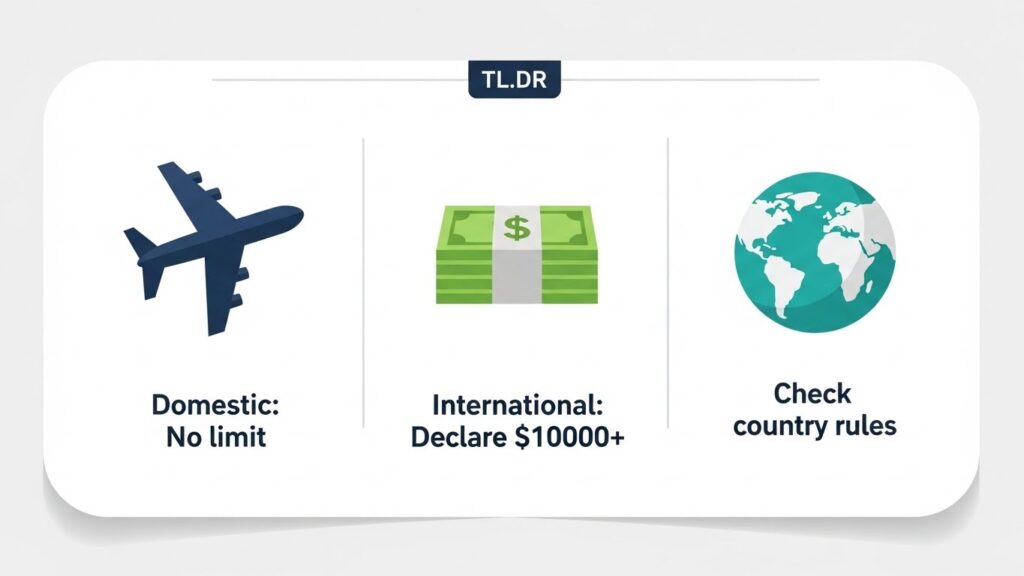
How Much Money Can You Take on a Plane?
Short Answer
If you are flying within the same country, there is usually no legal limit on how much cash you can take on a plane. For example, in the United States, the Transportation Security Administration does not set a cash limit.
If you are flying internationally, you must declare money over $10,000 (or equal value) when entering or leaving countries like the United States, the United Kingdom, and the European Union. If you don’t declare it, your money can be taken away.
Why This Matters (Quick Legal View)
This topic matters because many people mix up airport security rules with money laws. I see this mistake all the time, and it can cost you a lot of stress – or even your cash.
Here’s the simple truth: airport security and customs are not the same thing.
When you go through security, officers from the Transportation Security Administration focus on safety. They look for dangerous items, not how much money you carry. That’s why, on domestic flights, there is usually no cash limit.
But when you cross a border, different rules apply. That’s when customs officers step in, like U.S. Customs and Border Protection in the United States. Their job is to stop money laundering, tax evasion, and illegal activity. That’s why they require travelers to declare large amounts of cash.
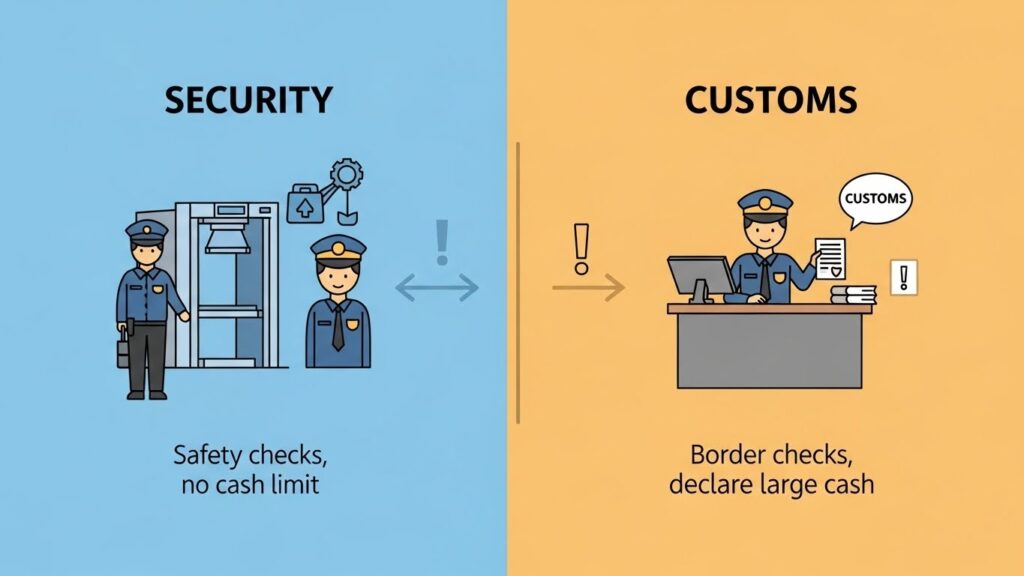
The key rule to remember is this:
If you carry $10,000 or more (or the same value in another currency) in or out of a country, you must declare it.
If you don’t, even if the money is clean and earned legally, officers can seize it on the spot. Getting it back can take months, sometimes longer.
That’s why knowing the rules before you fly is not optional – it’s smart money to travel.
What Counts as “Money” When You Fly?
This part surprises many people. When the law talks about “money,” it does not mean only paper cash in your wallet. I learned this the hard way while traveling.
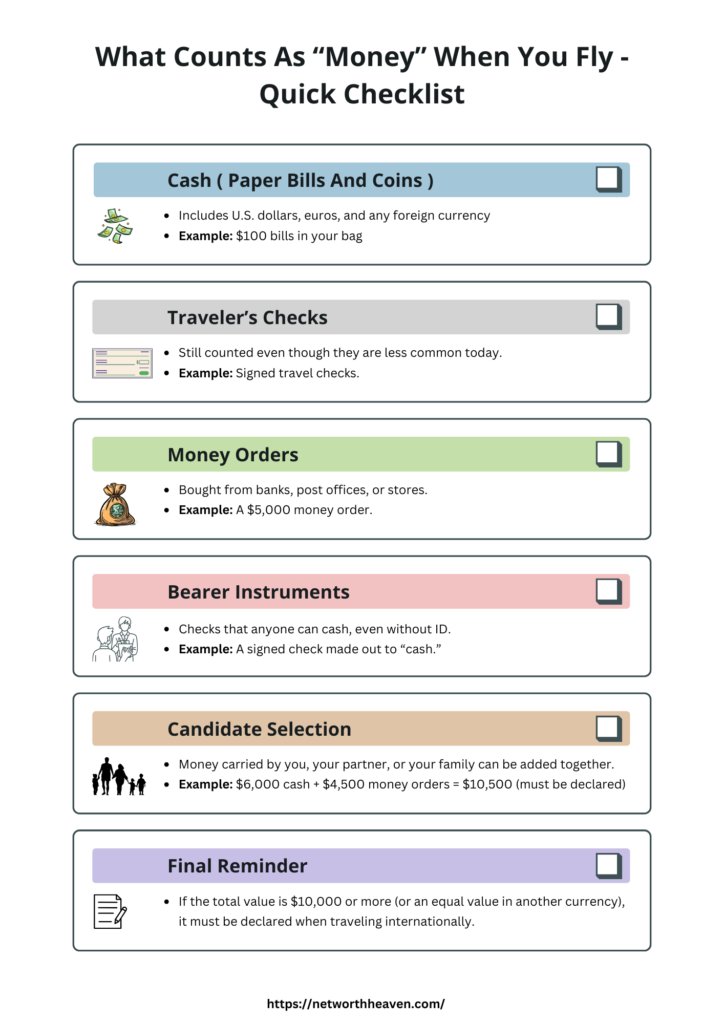
Here’s what usually counts as money at airports and border checks:
- Cash – Paper bills and coins, like U.S. dollars, euros, or any foreign currency.
Example: $100 bills in your bag. - Traveler’s checks – Old-school, but still counted.
Example: Signed travel checks. - Money orders – Bought from banks or stores.
Example: A $5,000 money order. - Bearer instruments – Checks that anyone can cash, even without ID.
Example: A signed check made out to “cash.” - Combined amounts – Money carried by you, your partner, or family can be added together.
So if you carry $6,000 in cash and $4,500 in money orders, that’s $10,500 total – and yes, that must be declared.
Country Cash Limits – Quick Table ( At-a-Glance )
Below is a simple, no-confusion table I use before traveling. It shows how much money you can carry before you must declare it when entering or leaving a country.
| Country / Region | Declare If You Carry More Than | Where You Declare | Important Notes |
| United States | $10,000 USD | Customs (FinCEN Form 105) | Applies when entering or leaving the U.S. |
| European Union | €10,000 | Local customs office | The rule applies at EU borders |
| United Kingdom | £10,000 | UK Customs | Family/group totals count |
| Australia | AUD 10,000 | Border Force / Arrival card | Applies on arrival & departure |
| Canada | CAD 10,000 | CBSA officer | Includes all monetary instruments |
| India | Depends on resident status | Indian Customs | Rules vary for residents & visitors |
Quick tip from me:
There is usually no maximum limit, only a declaration rule. Declaring does not mean your money is illegal – it just keeps you safe and stress-free.
Read More – Biography Of Danny Go Net Worth Wife & Life Story (2026)
How to Declare Money – Step by Step
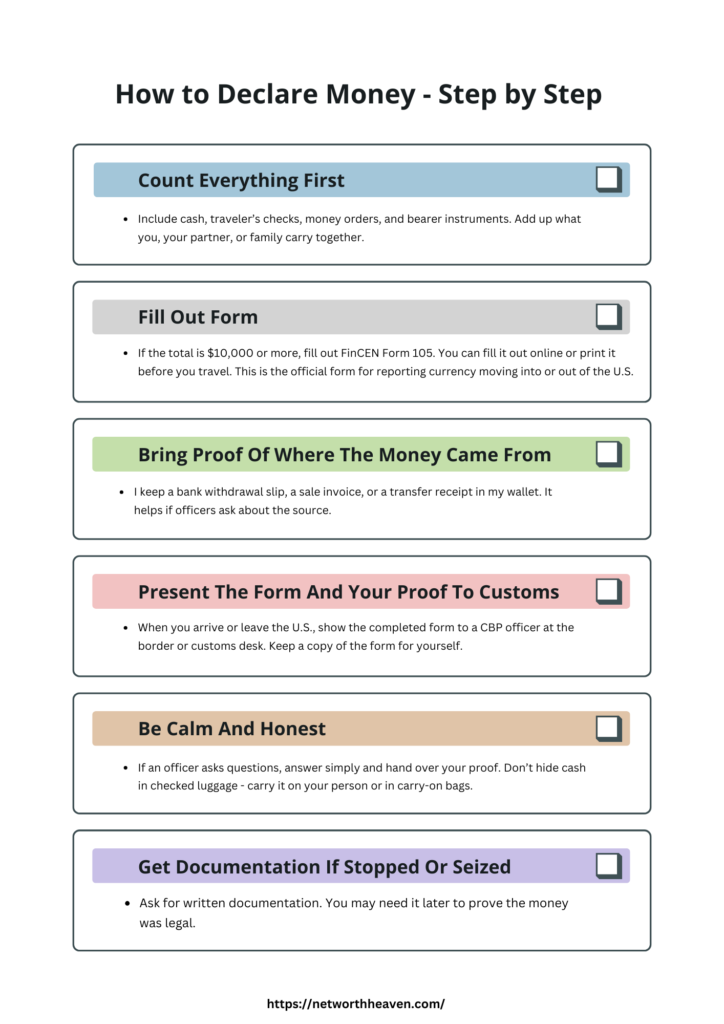
I’ll tell you exactly what I do when I travel with a lot of cash. Follow these simple steps, and you’ll be fine.
- Count everything first. Include cash, traveler’s checks, money orders, and bearer instruments. Add up what you, your partner, or family carry together.
- If the total is $10,000 or more, fill out FinCEN Form 105. You can fill it out online or print it before you travel. This is the official form for reporting currency moving into or out of the U.S.
- Bring proof of where the money came from. I keep a bank withdrawal slip, a sale invoice, or a transfer receipt in my wallet. It helps if officers ask about the source.
- Present the form and your proof to Customs. When you arrive or leave the U.S., show the completed form to a CBP officer at the border or customs desk. Keep a copy of the form for yourself.
- Be calm and honest. If an officer asks questions, answer simply and hand over your proof. Don’t hide cash in checked luggage – carry it on your person or in carry-on bags.
- If you’re stopped or money is seized, get a receipt. Ask for written documentation. You may need it later to prove the money was legal.
Quick notes for other countries: the rule is similar in the EU (€10,000), UK (£10,000), Australia (AUD 10,000), and Canada (CAD 10,000). Each place has its own form or arrival card—fill it out and declare it at customs.
That’s the simple path I follow: count, document, declare, and keep proof. It saves time and keeps your cash safe.
Smart, Real-World Tips I Always Follow (Safety + Practical)
Over the years, I’ve learned that how you carry money matters just as much as how much you carry. Here’s my personal “I do this every time” list.
- I always keep cash in my carry-on, never checking bags. Checked luggage can be lost or opened. I keep money on me or in a secure carry-on so I can see it at all times.
- I split my money into different places. I never keep all my cash in one pocket. Some stay in my wallet, some in a money belt, and some in my carry-on. If one part is lost, I’m not stuck.
- I don’t hide cash in strange places. Taping money to your body or stuffing it in shoes looks suspicious. If officers find it, they may ask more questions. I keep things simple and honest.
- I carry proof of where the money came from. This is huge. I bring bank withdrawal slips, sale receipts, or transfer records. If I’m carrying $15,000, I want to show it’s clean money.
- I declare early, not late. When I know I’m over the limit, I declare before anyone asks. This builds trust and avoids problems.
- I use cash only when I must. For large amounts, I prefer bank transfers, debit cards, or travel cards. They’re safer and easier.
- I stay calm and respectful. Border officers are doing their job. A calm tone and clear answers go a long way.
These habits have saved me time, stress, and money. Traveling smart is not about fear — it’s about being prepared.
Read More – Biography of George Foreman Net Worth 2025 – Full Profile
Frequently Asked Questions
Can airport security take my cash?
Security officers like the Transportation Security Administration don’t have a cash limit rule, but they can report large amounts to customs.
Is it illegal to fly with a lot of cash?
No. Carrying cash is legal. Problems start only when you fail to declare the required amounts on international flights.
What happens if I forget to declare money?
Customs officers can seize your cash, even if it’s legal money. Getting it back can take months.
Do family or group amounts count together?
Yes. If a family or group carries money together, authorities may add it up and require a declaration.
Can I carry cash on domestic flights?
Yes. On most domestic flights, there is no cash limit, but large amounts can still raise questions.
Is declaring money a bad thing?
Not at all. Declaring only means you are following the law. It does not mean your money is illegal.
Should I carry proof of where my money came from?
Yes. Bank slips or receipts help answer questions fast and reduce the risk of delays or seizures.
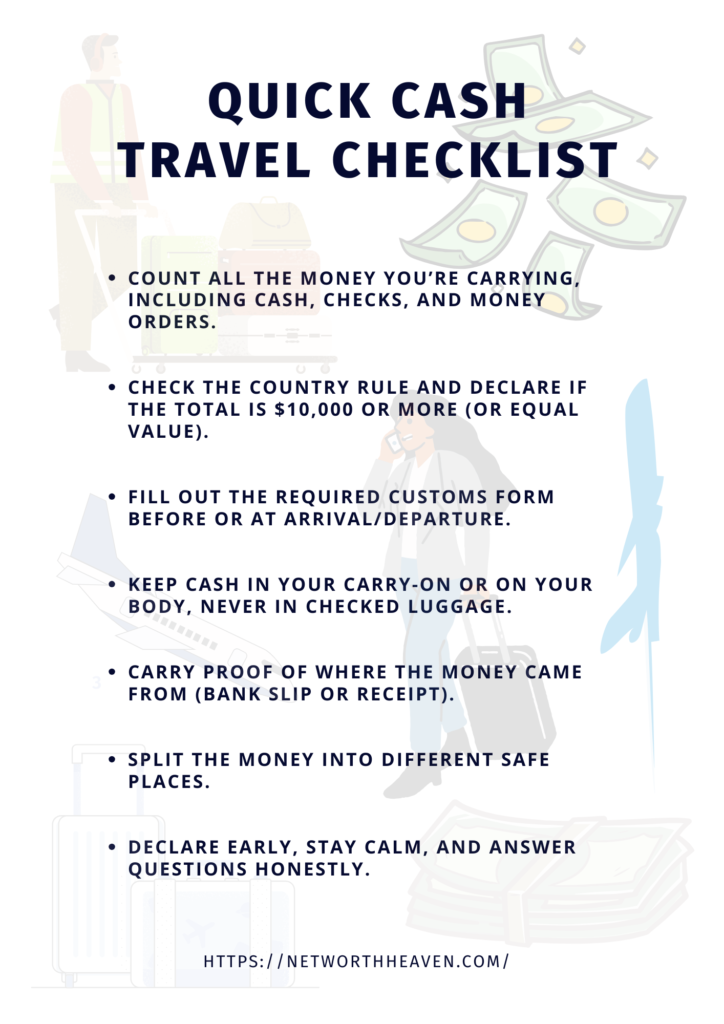
Quick Cash Travel Checklist (Print-Ready)
- Count all the money you’re carrying, including cash, checks, and money orders.
- Check the country rule and declare if the total is $10,000 or more (or equal value).
- Fill out the required customs form before or at arrival/departure.
- Keep cash in your carry-on or on your body, never in checked luggage.
- Carry proof of where the money came from (bank slip or receipt).
- Split the money into different safe places.
- Declare early, stay calm, and answer questions honestly.
Final Thoughts — My Honest Advice
After years of traveling with money, here’s my simple rule: carry only what you truly need. If I must travel with a large amount of cash, I count it, declare it, and keep proof. I never try to hide money or outsmart the system – that’s how people lose it.
Most problems happen because travelers don’t know the rules or ignore them. You don’t need to do that. Follow the steps, stay calm, and travel smart.
If you’re flying soon and want help for a specific country or situation, let me know.
I’m happy to guide you so you don’t make costly mistakes.
